- Angela’s Picks
- Shop by Age
- Shop by Category
- Shop by Values
- Montessori Toys
- Sensory Toys
- Teething Toys
- Wooden Toys
- Educational Toys
- Stacking & Sorting Toys
- Baby Bottles
- Sippy Cups
- Plates & Bowls
- Bibs
- Baby Utensils
- Deals
- High Chairs
- Breastfeeding & Nursing
- Snack Containers
- Crib Mattresses
- Bassinets
- Sleep Sacks & Swaddles
- Baby Blankets
- Baby Monitors
- Cribs & Nursery Furniture
- Baby Shampoo & Wash
- Baby Lotion & Oil
- Baby Sunscreen
- Bath Tubs & Seats
- Towels & Washcloths
- Diaper Cream & Balm
- Eco-Friendly Diapers
- Baby Wipes
- Potty Training
- Changing Pads
- Cloth Diapers
- Baby Thermometers
- Baby Proofing
- Baby Gates
- Humidifiers
- First Aid & Grooming
- Onesies & Bodysuits
- Sleepers & Pajamas
- Hats & Mittens
- Nursing Pads
- Breast Pumps & Accessories
- Postpartum Care
How to Choose Non-Toxic Toys: The Complete Safety Guide

Quick Answer
Learn how to choose safe, non-toxic toys for your baby and toddler. Certifications to trust, materials to avoid, and our top picks by age.
Babies put everything in their mouths. Everything. Which makes toy safety not just a nice-to-have but a critical health decision. The problem? Toy safety regulations in the US haven’t kept up with what we now know about chemical exposure.
The Chemicals to Watch For
Lead and heavy metals: Still found in painted toys, especially imports. Lead has no safe level for children. Look for third-party tested lead-free certification.
Phthalates: Plasticizers that make plastic soft and flexible. Linked to hormone disruption. Banned in some children’s products but still found in many toys not specifically marketed for babies.
BPA and BPS: Found in hard plastics. BPA is an endocrine disruptor. BPS (the common replacement) may not be much better. Choose BPA-free AND BPS-free, or skip plastic entirely.
Formaldehyde: Used in fabric treatments and wood finishes. A known carcinogen. Look for OEKO-TEX certified fabrics and natural/food-safe wood finishes.
PVC (polyvinyl chloride): The worst plastic for kids. Contains chlorine, often stabilized with lead or cadmium, and frequently softened with phthalates. If a toy smells like a new shower curtain, it’s probably PVC. Avoid it.
Children Learning Reading
Simple phonics program, 15 min/day
Get It →Certifications You Can Trust
OEKO-TEX Standard 100: Tests for over 100 harmful substances in textiles. This is the gold standard for fabric toys, stuffed animals, and clothing.
ASTM F963: US toy safety standard covering mechanical/physical hazards, flammability, and chemical safety. It’s the minimum, not the ideal.
EN 71 (European): Stricter than ASTM F963 on chemical limits. If a toy meets EN 71, it’s generally safer than one that only meets US standards.
GOTS (Global Organic Textile Standard): For organic cotton and wool toys. Covers both the organic fiber content and the processing chemicals.
FSC (Forest Stewardship Council): For wooden toys. Ensures sustainable wood sourcing, though doesn’t directly address chemical finishes.
Best Materials for Baby Toys
Natural rubber: Biodegradable, flexible, and safe for mouthing. Sophie la Girafe is the famous example. Make sure it’s 100% natural rubber, not synthetic.
Organic cotton: Soft, washable, and chemical-free when GOTS-certified. Great for stuffed animals and fabric toys.
Sustainably harvested wood: Maple, beech, and birch are popular choices. Must be finished with food-safe oils or water-based paints only. Unfinished is even better for mouthing toys.
Food-grade silicone: Heat-resistant, hypoallergenic, and doesn’t leach chemicals. Perfect for teethers and sensory toys. Look for platinum-cured silicone (highest grade).
Red Flags When Shopping
No brand or manufacturer listed. Strong chemical smell. Extremely low price for a complex toy (corners were cut somewhere). Paint that chips or flakes. Made for older children but marketed to babies. Vague claims like “non-toxic” without certification backing it up.
Our Top Non-Toxic Toy Picks by Age
0-6 months: mushie stacking rings (silicone), Manhattan Toy Winkel rattle (BPA-free), HABA wooden clutching toys
6-12 months: PlanToys wooden vehicles, Green Toys stacking cups (recycled milk jugs), Oli & Carol natural rubber bath toys
1-3 years: Grimm’s rainbow stacker (water-based stains), Melissa & Doug wooden puzzles, Green Toys indoor gardening kit
3-5 years: Tegu magnetic wooden blocks, Crayon Rocks soy-wax crayons, PlanToys dollhouse furniture
Materials & Certifications to Look For
Babies put everything in their mouths, so toy materials matter as much as the play value:
- Best materials: solid wood with non-toxic water-based finishes, food-grade silicone, organic cotton, and natural rubber.
- Avoid: soft PVC/vinyl (often contains phthalates), painted imports with unclear safety, and anything with a strong chemical smell.
- Never: small high-powered magnets or button batteries — swallowing these is a medical emergency.
- Certifications to trust: ASTM F963 and CPSIA (US safety), EN71 (Europe), and for finishes, look for non-toxic / lead-free labeling.
- Size matters: for under-3s, avoid anything that fits through a toilet-paper tube (a choking hazard).
Browse our vetted non-toxic toys, and check the CPSC recall list before buying secondhand.
Non-Toxic Toys We Love
| Product | Best For | Price | |
|---|---|---|---|
| Montessori Shape Sorter Wooden Toy | 1 Stop | Best Overall | $14.99 | View |
| DUMOS Wooden Baby Push Walker | 1 Stop | Best Value | $55.99 | View |
| Joyreal Wooden Noah's Ark Toy for Kids | Editor's Pick | $36.99 | View |
| Montessori Wooden Shape Sorting Toys for Toddlers Age | Great Choice | $22.49 | View |
| Montessori Wooden Learning Toys | Great Choice | $25.99 | View |
| GOPO TOYS Wooden Shape Sorter & Stacking Puzzle | Great Choice | $9.99 | View |
BEST OVERALL 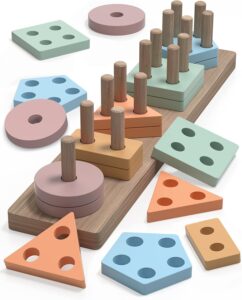
Montessori Shape Sorter Wooden Toy | 1 Stop Baby
$14.99
- Encourages fine motor skills: Chunky, easy-to-grasp pieces help enhance dexterity and hand-eye coordination.
- Promotes problem-solving: Sorting and stacking activities stimulate young minds and develop critical thinking.
- Color and shape recognition: With 5 vibrant colors and 5 distinct geometric shapes, children learn to identify and categorize as they play.
- Screen-free playtime: This engaging toy offers an alternative to screens, encouraging creativity and imaginative play.
- Safe and sturdy design: Built with durable materials and smooth edges, ensuring safe play for your little ones.
BEST VALUE 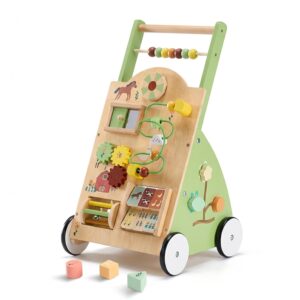
DUMOS Wooden Baby Push Walker | 1 Stop Baby
$55.99
- Encourages early walking skills while promoting balance and coordination.
- Adjustable speed feature that grows with your child’s confidence and abilities.
- Silent rubber wheels that glide smoothly, preserving the serenity of your home.
- Montessori-inspired design that fosters independence and creativity during play.
- Crafted from natural wood, ensuring a durable and long-lasting toy that can be passed down.
EDITOR'S PICK 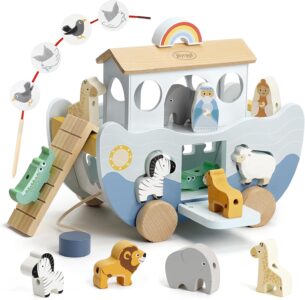
Joyreal Wooden Noah's Ark Toy for Kids
$36.99
- Complete Set: Includes intricately designed figurines of Noah and Naamah, 8 pairs of animals, and fun accessories like a ladder and rainbow, sparking endless storytelling possibilities.
- Faith-Based Learning: Encourages parents and children to act out the Noah's Ark story, helping teach moral values such as gratitude, kindness, and faith.
- Skill Development: Features built-in activities like sorting and stacking that enhance fine motor skills and hand-eye coordination, all while encouraging creativity.
- Gender-Neutral Design: The stylish, neutral tones and boho rainbow decor make it suitable for any child, seamlessly fitting into any nursery or playroom.
- Meaningful Gift: Perfect for special occasions, this toy combines educational value with spiritual significance, making it a thoughtful gift for baptisms, birthdays, and holidays.

Montessori Wooden Shape Sorting Toys for Toddlers Age 1-3
$22.49
- Encourages fine motor skill development through engaging shape sorting activities.
- Promotes color and shape recognition with colorful, appealing designs.
- Offers various play methods, including sorting, matching, and imaginative play.
- Supports social interaction as toddlers can enjoy playing together and build friendships.
- Crafted from high-quality wood with polished edges, ensuring a safe play experience.
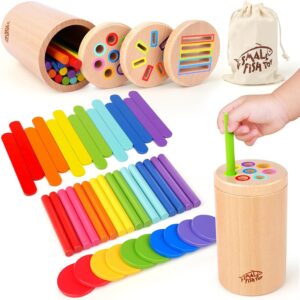
Montessori Wooden Learning Toys
$25.99
- Enhances Fine Motor Skills: The act of inserting colored wooden sticks into various holes promotes dexterity and hand-eye coordination.
- Encourages Color Recognition: With 16 vibrant sticks and 10 discs, toddlers can easily connect colors while they play.
- Promotes Spatial Awareness: The different shapes and stacking options help children develop their sense of direction and spatial concepts.
- Supports Imagination: The open-ended design allows for creative play, encouraging innovation and exploration.
- Easy to Organize and Transport: The canvas drawstring bag makes it convenient to carry to playdates or outings.
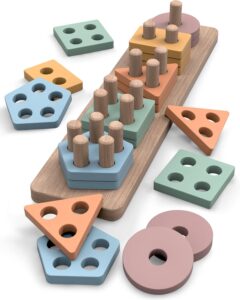
GOPO TOYS Wooden Shape Sorter & Stacking Puzzle
$9.99
- Promotes problem-solving: Children engage in stacking, sorting, and matching activities that enhance logical thinking.
- Supports fine motor skills: The chunky wooden pieces are designed to strengthen hand grip and coordination through tactile tasks.
- Screen-free play: This toy fosters calm, focused engagement, allowing children to explore their creativity without overstimulation.
- Durable and long-lasting: Made from solid wood, this toy can withstand daily play, ensuring longevity for years of enjoyment.
- Organized play: The 20-piece set is neatly stored in a self-contained board, making clean-up easy and ensuring no pieces go missing.
As an Amazon Associate we earn from qualifying purchases. We only recommend products we'd use ourselves — we're never paid for placement.
Frequently Asked Questions
Are wooden toys always non-toxic?
Usually, but not automatically — the finish matters. Look for solid wood (not particleboard, which can off-gas formaldehyde) sealed with non-toxic, water-based paint or natural oils. Unfinished or beeswax-finished wood is the safest of all.
What plastics should I avoid in baby toys?
Avoid soft PVC/vinyl (plastic #3), which may contain phthalates, and any toy with a strong plastic smell. Choose food-grade silicone or hard plastics labeled BPA-, PVC-, and phthalate-free — or skip plastic in favor of wood and natural rubber.
Angela's Recommended Resources
Guides and courses I personally recommend:
Children Learning Reading
Phonics-based reading program for young children. Simple 15-minute daily lessons that work.
* Affiliate links. We may earn a commission at no extra cost to you.