- Angela’s Picks
- Shop by Age
- Shop by Category
- Shop by Values
- Montessori Toys
- Sensory Toys
- Teething Toys
- Wooden Toys
- Educational Toys
- Stacking & Sorting Toys
- Baby Bottles
- Sippy Cups
- Plates & Bowls
- Bibs
- Baby Utensils
- Deals
- High Chairs
- Breastfeeding & Nursing
- Snack Containers
- Crib Mattresses
- Bassinets
- Sleep Sacks & Swaddles
- Baby Blankets
- Baby Monitors
- Cribs & Nursery Furniture
- Baby Shampoo & Wash
- Baby Lotion & Oil
- Baby Sunscreen
- Bath Tubs & Seats
- Towels & Washcloths
- Diaper Cream & Balm
- Eco-Friendly Diapers
- Baby Wipes
- Potty Training
- Changing Pads
- Cloth Diapers
- Baby Thermometers
- Baby Proofing
- Baby Gates
- Humidifiers
- First Aid & Grooming
- Onesies & Bodysuits
- Sleepers & Pajamas
- Hats & Mittens
- Nursing Pads
- Breast Pumps & Accessories
- Postpartum Care
Best Montessori Toys by Age: 0-5 Years Guide

Quick Answer
Discover the best Montessori toys for every age from 0-5 years. Natural materials, developmental benefits, and age-appropriate picks.
Montessori toys are having a moment, and honestly, it is well deserved. The philosophy behind them is simple: give children beautiful, purposeful toys made from natural materials, and get out of their way. No batteries, no flashing lights, no electronic voices telling them they are doing a great job. Just the toy, the child, and whatever magic their imagination creates.
What Makes a Toy Montessori?
True Montessori toys share a few key characteristics: they are made from natural materials (wood, cotton, metal, silk), they serve one purpose (isolating a single skill), they are realistic rather than fantasy-based (for young children), and they are beautiful, because children deserve beauty. They also tend to be open-ended, meaning the child decides how to use them.
Best Montessori Toys
| Product | Best For | Price | |
|---|---|---|---|
| MINGKIDS Montessori Toys for 1 Year Old,Baby Sorter | Best Overall | $12.99 | View |
| TOHIBEE Baby Montessori Sensory Toys for 0-12 Months | Best Value | $9.99 | View |
| Busy Cube Toys for 1 Year Old Boy | Editor's Pick | $9.99 | View |
| Montessori Wooden Shape Sorting Toys for Toddlers Age | Great Choice | $22.49 | View |
| MINGKIDS Montessori Toys for 1 Year Old, 6 | Great Choice | $12.99 | View |
| Montessori Wooden Shape Sorter Toy for Toddlers 1-3 | Great Choice | $13.99 | View |
BEST OVERALL 
MINGKIDS Montessori Toys for 1 Year Old,Baby Sorter Toy Colorful Cube
$12.99
- Encourages fine motor skills: Little hands will enjoy manipulating and sorting colorful shapes, enhancing dexterity and coordination.
- Interactive play: The open sides and elastic strips make it easy for children to push shapes in and out, promoting independent exploration.
- Durable design: Built to withstand robust play, this lightweight toy will last through countless adventures.
- Colorful and engaging: The vibrant colors and varied shapes capture children's attention, keeping them entertained while they learn.
- Perfect gift choice: Ideal for birthdays, holidays, or special occasions, this toy is a thoughtful present that will be cherished for years.
BEST VALUE 
TOHIBEE Baby Montessori Sensory Toys for 0-12 Months
$9.99
- Bright colors and textures grab your baby’s attention, promoting visual and tactile exploration.
- The ergonomic design fits perfectly in tiny hands, encouraging grasping and improving fine motor skills.
- Soft silicone and high-quality ABS plastic provide soothing relief for teething discomfort, making it a must-have for babies aged 0-12 months.
- Compact and lightweight, it’s an essential travel companion that can easily fit into diaper bags for on-the-go fun.
- This versatile toy doubles as a rattle and teether, offering multiple ways for your baby to play and learn.
EDITOR'S PICK 
Busy Cube Toys for 1 Year Old Boy - Montessori Sensory Toy
$9.99
- Encourages parent-child bonding through collaborative play.
- Enhances hand-eye coordination and fine motor skills through various activities.
- Supports problem-solving abilities and concentration with engaging challenges.
- Compact size makes it ideal for travel—perfect for road trips or airplanes.
- Robust design ensures durability, making it a long-lasting investment in your child’s development.

Montessori Wooden Shape Sorting Toys for Toddlers Age 1-3
$22.49
- Encourages fine motor skill development through engaging shape sorting activities.
- Promotes color and shape recognition with colorful, appealing designs.
- Offers various play methods, including sorting, matching, and imaginative play.
- Supports social interaction as toddlers can enjoy playing together and build friendships.
- Crafted from high-quality wood with polished edges, ensuring a safe play experience.

MINGKIDS Montessori Toys for 1 Year Old, 6 Pc Set
$12.99
- Engaging Sensory Experience: The six chunky shape blocks invite your child to explore different textures and colors, enhancing their sensory perception.
- Promotes Early Learning: Designed to support shape and color recognition, this toy helps lay the groundwork for future learning.
- Safe Playtime: Constructed from high-quality ABS plastic with rounded edges, this toy is safe for little ones to handle without the risk of injury.
- Durable and Long-lasting: Made with sturdy materials that withstand rough play, ensuring it can keep up with your child's adventurous spirit.
- Ideal Gift Option: This activity cube makes a fantastic gift for birthdays or holidays, delighting both children and parents alike.

Montessori Wooden Shape Sorter Toy for Toddlers 1-3 Years
$13.99
- Encourages early learning: Introduces toddlers to color recognition and shape identification through hands-on play.
- Supports fine motor skills: The moderate geometric sizes and smooth edges are perfect for tiny hands to grasp and manipulate.
- Promotes problem-solving: Children can explore various ways to sort and stack, fostering independent thinking and creativity.
- Safe materials: Made from high-quality wood and coated with vibrant, water-based paint that is non-toxic and odorless.
- Versatile play options: Functions as a sorting toy, stacking puzzle, and imaginative play set, keeping playtime exciting and engaging.
As an Amazon Associate we earn from qualifying purchases. We only recommend products we'd use ourselves — we're never paid for placement.
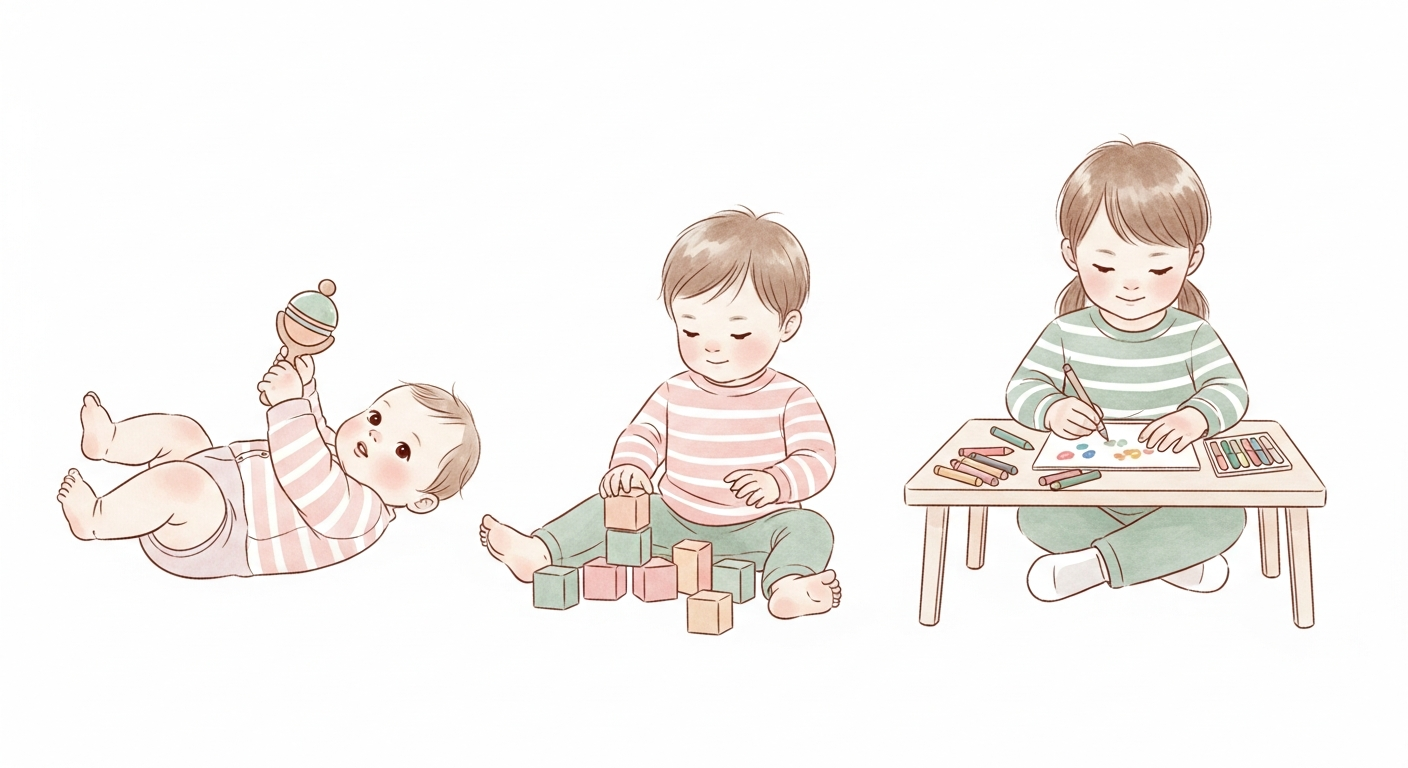
0-6 Months: Engaging the Senses
- Munari mobile – Black and white geometric shapes for visual tracking. The classic first Montessori toy.
- Wooden rattle – Simple, lightweight, easy to grasp. Develops hand-eye coordination.
- Organic cotton ball – A crocheted or fabric ball that is easy for tiny hands to grab and mouth safely.
- Contrast cards – High-contrast black and white images for visual development.
6-12 Months: Exploring Movement
- Object permanence box – A ball drops in the hole and comes out the side. Endlessly fascinating.
- Stacking rings – Wooden rings on a dowel. Simple, enduring, teaches size ordering.
- Wooden egg and cup – Teaches hand coordination and the concept of containment.
- Push walker – A weighted wooden cart for pulling up and learning to walk.
- Nesting bowls – Wooden or stainless steel bowls of graduated sizes.
1-2 Years: Building Skills
- Shape sorter – Wooden shapes that fit into matching holes. Start simple with just a circle.
- Peg puzzle – Large-knob wooden puzzles with 3-5 pieces.
- Bead maze – Develops fine motor skills and hand-eye coordination.
- Wooden blocks – The ultimate open-ended toy. A good set lasts years.
- Practical life tools – Child-sized broom, watering can, or cleaning cloth.
2-3 Years: Independence and Creativity
- Lacing beads – Large wooden beads with a thick lace. Great for concentration.
- Play kitchen tools – Real (child-safe) knife and cutting board for helping in the kitchen.
- Magnetic tiles – Open-ended building with infinite possibilities.
- Art supplies – Beeswax crayons, natural clay, watercolors. Creativity without toxic materials.
- Dress-up frames – Buttons, zippers, snaps, and buckles to practice self-dressing.
3-5 Years: Abstract Thinking
- Counting materials – Wooden numbers with corresponding quantities.
- Moveable alphabet – Wooden or felt letters for pre-reading exploration.
- Geography puzzle – Wooden world map puzzle.
- Construction sets – Wooden building systems for engineering play.
- Nature exploration kit – Magnifying glass, bug container, binoculars. Real tools, not toy versions.
Choosing Non-Toxic Montessori Toys
Most quality Montessori toys naturally tick the non-toxic box because they prioritize natural materials. Look for solid hardwood with water-based or plant-based finishes, organic cotton and natural dyes for fabric toys, food-grade silicone for any silicone components, and EN71 or ASTM F963 safety certification.
The best investment is a few high-quality toys rather than a mountain of cheap ones. One beautiful wooden block set will outlast and out-entertain a hundred plastic gadgets. And bonus: your living room will look a lot better.
What Makes a Toy “Montessori”?
Montessori toys aren’t a brand — they’re a philosophy. The best ones share a few traits:
- Real, natural materials — wood, cotton, metal, and silicone over flashing plastic. They feel and sound different, which feeds the senses.
- One clear purpose. A simple stacker or shape-sorter lets a child master a single concept, building focus and confidence.
- Child-led, not battery-led. The child does the work (and the thinking), rather than passively watching lights and sounds.
- Open-ended & realistic. Toys that reflect the real world (a wooden kitchen, animals to name) over fantasy gadgets.
- Beautiful and simple, displayed on a low shelf with just a few choices to avoid overwhelm.
You don’t need a shelf full of pricey gear — a few well-chosen non-toxic wooden toys rotated regularly beats a toy box of plastic.
Frequently Asked Questions
At what age can you start Montessori toys?
From birth — newborns benefit from high-contrast mobiles and simple grasping toys, and the approach grows with your child. The key is matching the toy to your baby’s current stage so it’s challenging but achievable.
Are Montessori toys worth it?
Many parents find they are — simple, well-made toys hold attention longer, build real skills, and last for years (often becoming hand-me-downs). You don’t need many; a few quality pieces rotated regularly is the Montessori way and is often cheaper over time than a constant stream of plastic toys.
Angela's Recommended Resources
Guides and courses I personally recommend:
Children Learning Reading
Phonics-based reading program for young children. Simple 15-minute daily lessons that work.
* Affiliate links. We may earn a commission at no extra cost to you.